The Crisis of Science and the Survival of Technology in The Three-Body Problem
Introduction
There are many ways to read The Three-Body Problem by Liu Cixin.
As a first-contact novel. As hard science fiction. As a cosmological thriller. As geopolitical speculation.
Yet one of its deepest themes is often left in the background: the distinction between the crisis of science and the continuity of technology.
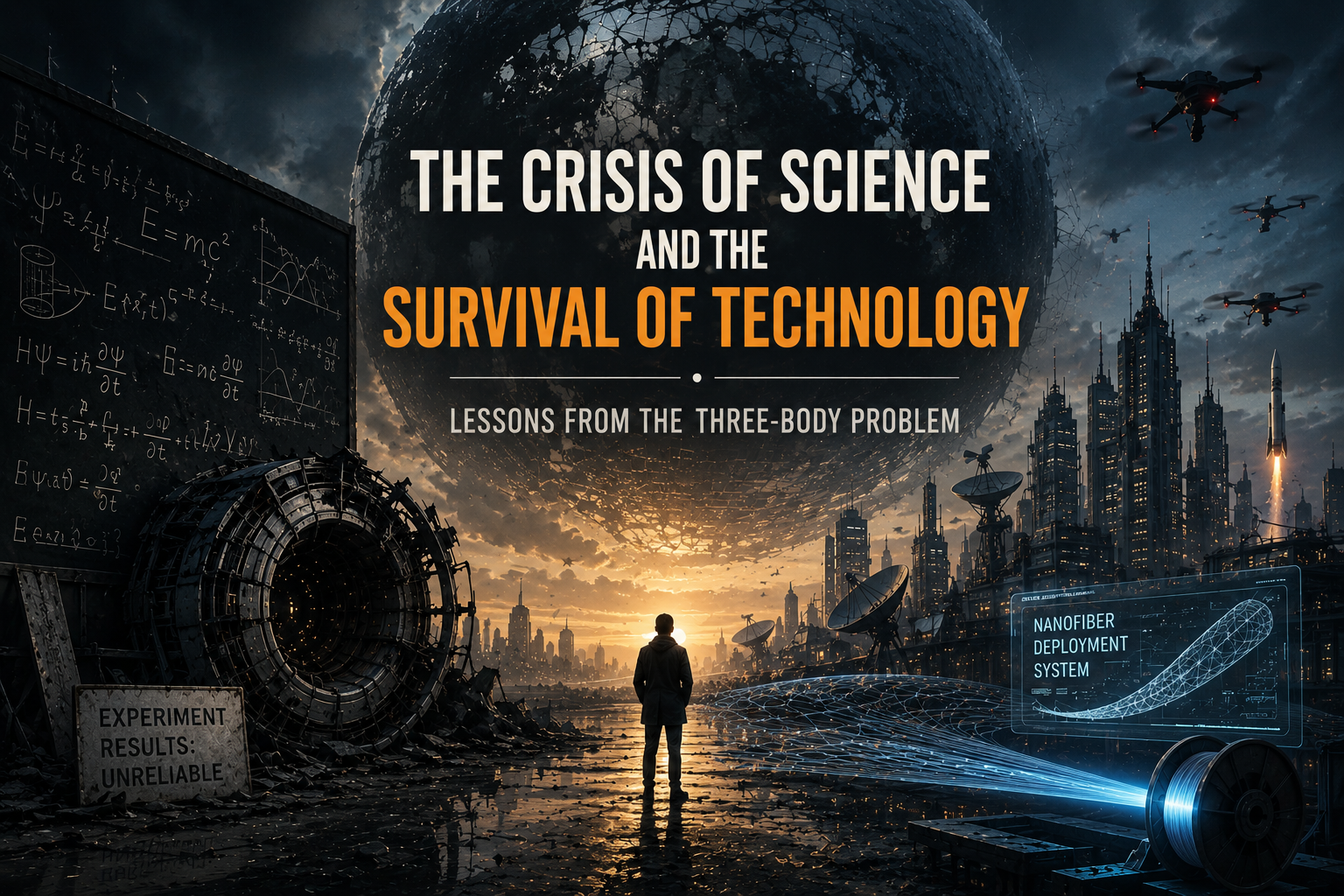
In the novel, fundamental physics enters a state of epistemological paralysis. Particle accelerators stop producing coherent results, experiments become unreliable, and scientists lose faith in the very possibility of understanding reality. This is not merely a theoretical crisis: it is the collapse of the relationship between observation and truth.
Modern science rests upon a powerful implicit assumption: the world must be stable enough to allow experimental reproducibility. Once that stability is sabotaged, science loses its operational ground.
And yet human civilization does not collapse.
Technology continues to function.
Technology Beyond Science
Networks remain active. Military systems continue to operate. Nanotechnologies are developed. Global organizational capacity remains intact. One of the novel’s most emblematic scenes — the destruction of the ship through nanofiber wires — does not emerge from a new scientific revolution, but from the extreme application of already existing knowledge.
It is here that the novel introduces a radical distinction between theoretical knowledge and technical capability.
Technology survives epistemological crisis.
Historically, this is not an absurd idea. Many technologies preceded a full theoretical understanding of how they worked. The steam engine came before modern thermodynamics. Metallurgy existed long before scientific chemistry. Even some uses of electricity anticipated Maxwell’s formal theories.
But Liu Cixin pushes this separation to its extreme consequences: a civilization may continue to build, organize, and fight even while losing its capacity to generate new fundamental knowledge.
Kuhn, Feyerabend, and the Fragility of Knowledge
In this sense, the novel enters into an implicit dialogue with Thomas Kuhn and Paul Feyerabend.
Kuhn showed that science does not advance linearly toward truth, but through historically situated paradigms. “Normal science” exists only as long as a community shares methods, instruments, languages, and criteria of validation.
Feyerabend, meanwhile, criticized the very idea of a universal and stable scientific method, insisting on the historical, chaotic, and often contradictory nature of real scientific practice.
In the novel, this epistemological fragility becomes strategic vulnerability.
The Trisolarans do not initially attack cities or armies. They attack the cognitive conditions of civilization itself. They destroy confidence in the intelligibility of the world.
It is an epistemological war.
The Trauma of the Cultural Revolution
This is where the context of contemporary China becomes essential.
The novel’s opening during the Cultural Revolution is not simply historical background. It is the moment in which Liu Cixin demonstrates that scientific knowledge can be politically delegitimized and destroyed. The ideological violence against intellectuals represents the novel’s original trauma.
What matters, however, is that post-Mao China did not respond by rejecting technology. On the contrary, it built an enormous modernization project grounded in infrastructure, engineering, technological planning, and organizational capacity.
This tension runs throughout the novel.
Theoretical science appears fragile, vulnerable, and potentially destabilizing. Technology, by contrast, continues to generate operational order.
A Post-Epistemological Modernity
For this reason, The Three-Body Problem is not simply a novel about the crisis of science. It is a novel about the survival of technological civilization beyond the epistemological horizon that gave rise to it.
European Enlightenment modernity imagined a relatively linear continuity:
science → technology → progress
In the novel, this chain is broken.
Technology continues to advance even as the fundamental understanding of reality enters into crisis.
And this may be the novel’s most disturbing insight: humanity does not regress into primitivism. It remains highly technological, militarily efficient, and organizationally sophisticated.
But it risks becoming a civilization capable of building without truly understanding why the world works.
Conclusion
The great intuition of The Three-Body Problem may ultimately be this: science is not inevitable.
It is not an automatic, linear, irreversible process. It is a fragile historical construction, dependent upon social stability, institutional trust, and cultural continuity. It can be sabotaged. It can be politicized. It can even collapse.
Technology, however, possesses a different capacity for survival. Once embedded within the structures of civilization — infrastructures, production systems, military apparatuses, and administrative networks — it continues to operate even when its theoretical foundations begin to fail.
It is this dissociation between understanding and operability that makes the novel feel so contemporary.
Because the true horror imagined by Liu Cixin is not merely alien contact. It is the possibility of a civilization that remains technologically powerful while becoming epistemologically disoriented: a civilization that continues to manipulate the world without being certain it still understands it.