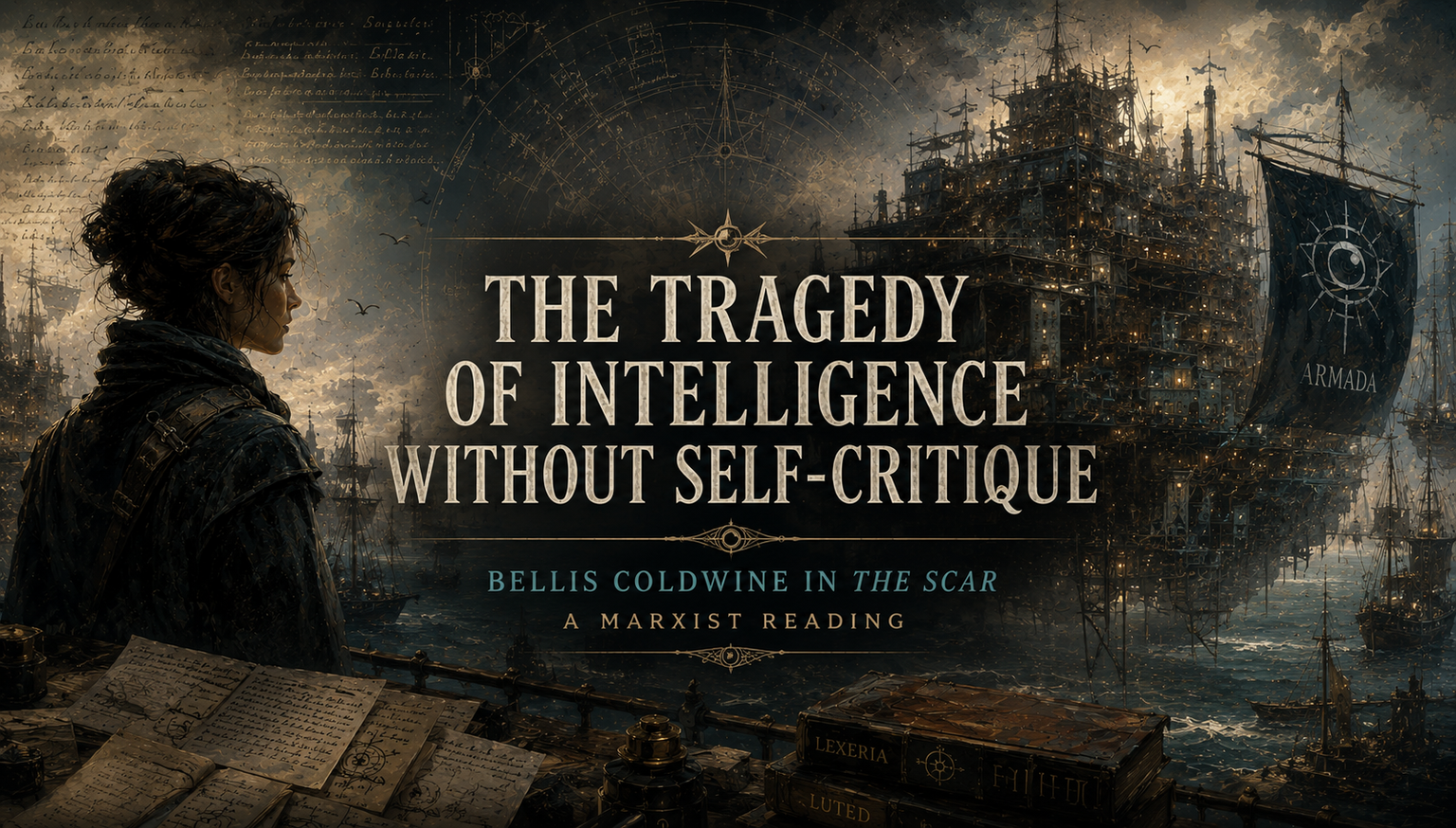
The Tragedy of Intelligence Without Self-Critique in The Scar
Introduction
Within contemporary fantasy, few works interrogate the role of the intellectual as sharply as The Scar by China Miéville. Far removed from epic heroism and any consolatory myth, the novel constructs a world in which knowledge and power do not coincide, and where intelligence offers no guarantee of emancipation.
At the center of this tension stands Bellis Coldwine: a linguist, an observer, an educated and seemingly self-aware figure. Yet it is precisely through her that one of the novel’s most radical insights emerges—one that can be read through a Marxist lens: consciousness does not automatically entail awareness of one’s position within social relations.
The tragedy of intelligence without self-critique.
The Intellectual and Historical Position
Bellis embodies a figure long identified in Marxist thought as problematic: the intellectual who belongs neither to the ruling class nor to a collective subject capable of transformation. She possesses refined analytical tools, yet lacks political grounding.
Her knowledge remains suspended. It never becomes praxis. It is a form of consciousness that observes the world without locating itself within it as an agent of change. Bellis sees, but does not intervene in any structured sense; she understands, but does not take a position.
The Gaze as Distance
One of Bellis’s defining traits is her gaze. She observes everything: Armada, the Lovers, the power dynamics that shape the floating city. Yet this gaze, rather than drawing her closer, maintains her distance.
Distance becomes both a defense and a limitation. In Marxist terms, Bellis never overcomes the separation between subject and social totality. She remains trapped in a fragmented perception, unable to connect what she sees to a larger system of relations.
Being Within Power Without Recognizing It
Bellis is not merely a victim of power structures; she is embedded within them. Her linguistic expertise makes her useful, even necessary. It is precisely through knowledge that she becomes integrated into Armada’s mechanisms.
What is missing is recognition. She never develops a critical awareness of her own position. Here lies a deeply Marxist tension: ideology is not only false consciousness, but also the inability to perceive one’s place within systems of power and production.
Bellis acts within the system while continuing to imagine herself outside it.
Action Without Self-Awareness
Bellis’s decisions carry real, sometimes devastating consequences. She is not passive. And yet, her actions are never accompanied by critical reflection.
There is no moment of radical self-questioning. Her choices remain pragmatic, defensive, individual. Her intelligence is always directed outward, never inward.
This gap between action and reflection produces the central fracture of her character: Bellis participates in history, but never becomes a historical subject.
The Refusal of the Collective
While other characters, however ambiguously, engage with collective transformation, Bellis remains tied to an individual perspective. Her desire to return to New Crobuzon is not merely nostalgia, but a refusal of change.
From a Marxist perspective, she fails to develop a consciousness that extends beyond the individual. The collective appears not as a possibility, but as a constraint. This isolates her, both psychologically and politically.
Armada as an Unresolved Enigma
Armada represents an unstable political experiment, a quasi-utopia that resists clear categorization. Bellis never fully interprets it. She neither embraces nor meaningfully critiques it.
She remains suspended, unable to take a position. This is not neutrality, but the symptom of a deeper limitation: the inability to grasp totality, and therefore to act within it.
Conclusion
Bellis Coldwine is not a failed heroine, but a tragically coherent figure. Her intelligence is real, her analytical capacity undeniable. Yet it is precisely this intelligence, devoid of self-critique, that becomes her greatest limitation.
In the world of The Scar, understanding is not enough. Without reflection on one’s own role, without the ability to situate oneself within social relations, knowledge risks becoming impotence.
In this sense, Bellis embodies one of Miéville’s most radical critiques: that of the intellectual who observes the world without interrogating their place within it. A figure who, despite seeing everything, remains unable to transform what she sees.
Her tragedy is not error, but the failure to recognize error.
And for that reason, she stands as one of the most strikingly contemporary figures in modern fantasy.