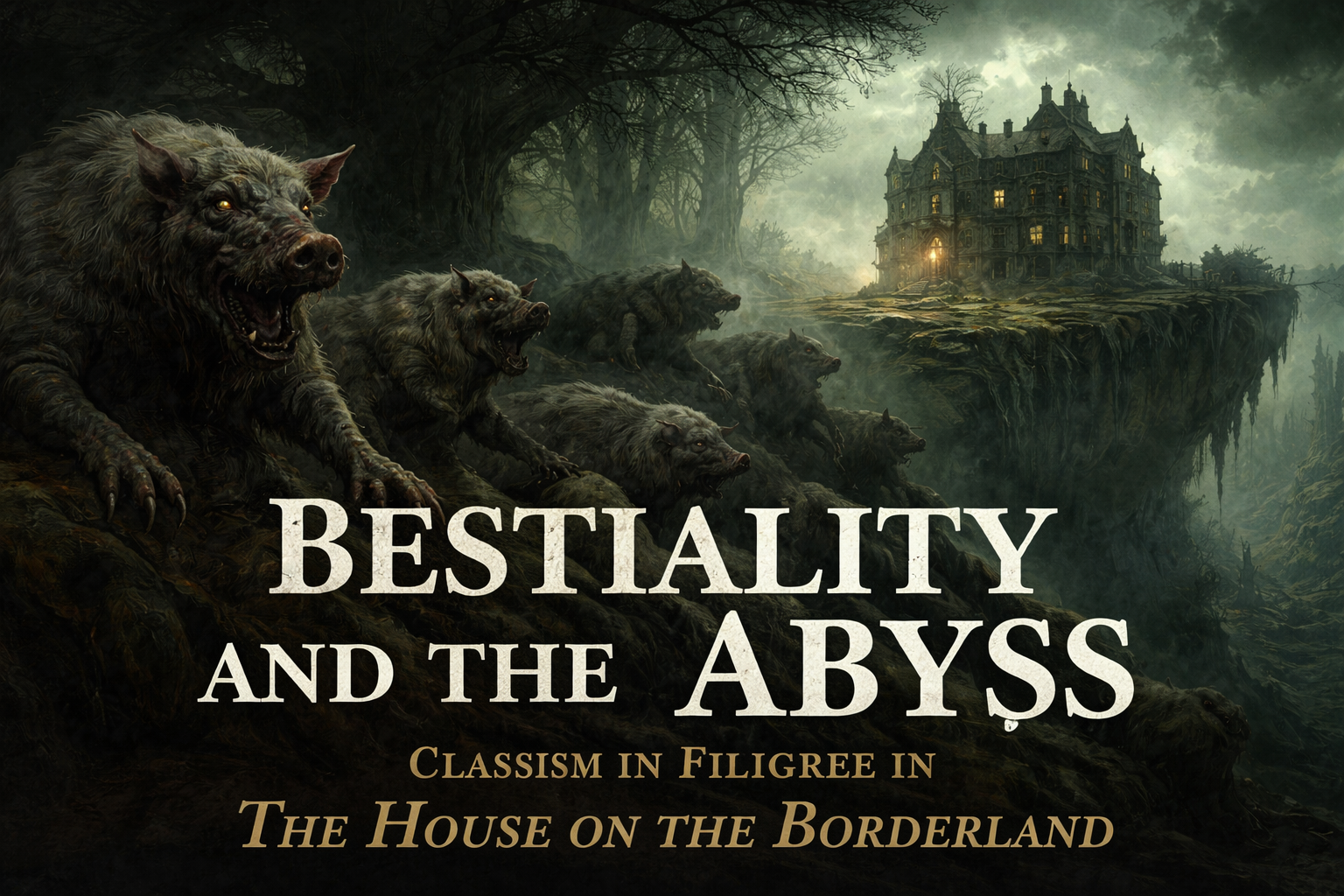
Bestiality and the Abyss: Classism in Filigree in The House on the Borderland by William Hope Hodgson
Introduction
Published in 1908, The House on the Borderland by William Hope Hodgson is now widely recognized as a foundational text of weird fiction. Critics have often emphasized its role in anticipating twentieth-century cosmic horror, particularly in relation to the work of H. P. Lovecraft. Yet alongside its metaphysical and cosmological dimensions, the novel appears to retain — in a more subtle and indirect form — traces of a social imaginary deeply rooted in its historical context.
This article proposes to explore a “filigree” reading of the text: the presence of an underlying discourse of degeneration which, while not constituting an explicit classist argument, reflects a cultural climate in which the boundary between biological inferiority and social inferiority was often blurred.
Degeneration and Fin-de-Siècle Culture
Between the late nineteenth and early twentieth centuries, the concept of “degeneration” occupied a central place in European scientific and cultural discourse. Pseudo-scientific theories, often associated with criminology and anthropology, tended to interpret deviance, poverty, and marginality as signs of evolutionary regression.
Within this framework, the idea of a humanity threatened by inferior forms — or by its own potential regression — became a recurring theme. This imaginary was not necessarily overtly political, but it was shaped by a hierarchical vision of the human, in which the “low” (biological, moral, or social) was perceived as a source of danger.
The Swine-Creatures: Alterity or Regression?
The enigmatic “swine-things” that besiege the house are among the most disturbing elements of the novel. Described as hybrid beings, vaguely anthropomorphic yet profoundly bestial, they seem to inhabit a liminal zone between the human and the non-human.
It is important to stress that within the text:
- there is no direct reference to any social class;
- the creatures are not linked to an urban or labor context;
- their origin appears cosmic or metaphysical rather than historical.
This makes it difficult to interpret them as a direct representation of the working class or any specific social group.
And yet, their depiction insists on features that, within the cultural framework of the time, could evoke the idea of degeneration:
- marked animality;
- loss of rationality;
- collective and indistinct threat;
- the siege of a “civilized” space.
Classism as an Implicit Structure
Rather than a direct representation, it is more convincing to speak of an implicit or structural form of classism. The swine-creatures do not embody a class, but they participate in an imaginary that tends to:
- associate degradation with animality;
- conceive alterity as regression;
- construct an opposition between a center (the house, consciousness, order) and a threatening, indistinct periphery.
In this sense, the novel reflects a tension characteristic of modernity: the fear that what is “other” — and potentially “inferior” — might invade and dissolve human identity.
Beyond the Social: The Abyss as Universal Destiny
Reducing the swine-creatures to a purely social symbol would, however, be limiting. The power of the novel lies precisely in its movement toward a more radical dimension: degeneration is not merely a social possibility, but an ontological condition.
Throughout the narrative, the protagonist experiences cosmic visions that undermine any sense of human centrality:
- time expands across incomprehensible scales;
- the universe drifts toward cooling and dissolution;
- humanity appears as a transient phase.
Within this perspective, the swine-creatures may be interpreted as a possible form of the human — past or future — inscribed within an ongoing process of transformation.
Conclusion
The House on the Borderland is not a “classist” novel in any direct sense. Nevertheless, it belongs to a cultural horizon in which the fear of degeneration permeates both scientific and literary discourse, at times conflating biological and social categories.
The swine-creatures do not represent a class, but they evoke an idea of regression that, within the historical context of the work, could easily intersect with broader social anxieties. Hodgson, however, ultimately transcends this dimension, transforming degeneration into a cosmic question: not the fate of a few, but a possibility embedded in existence itself.
It is perhaps precisely in this shift — from the social to the metaphysical — that the novel reveals its most unsettling modernity.