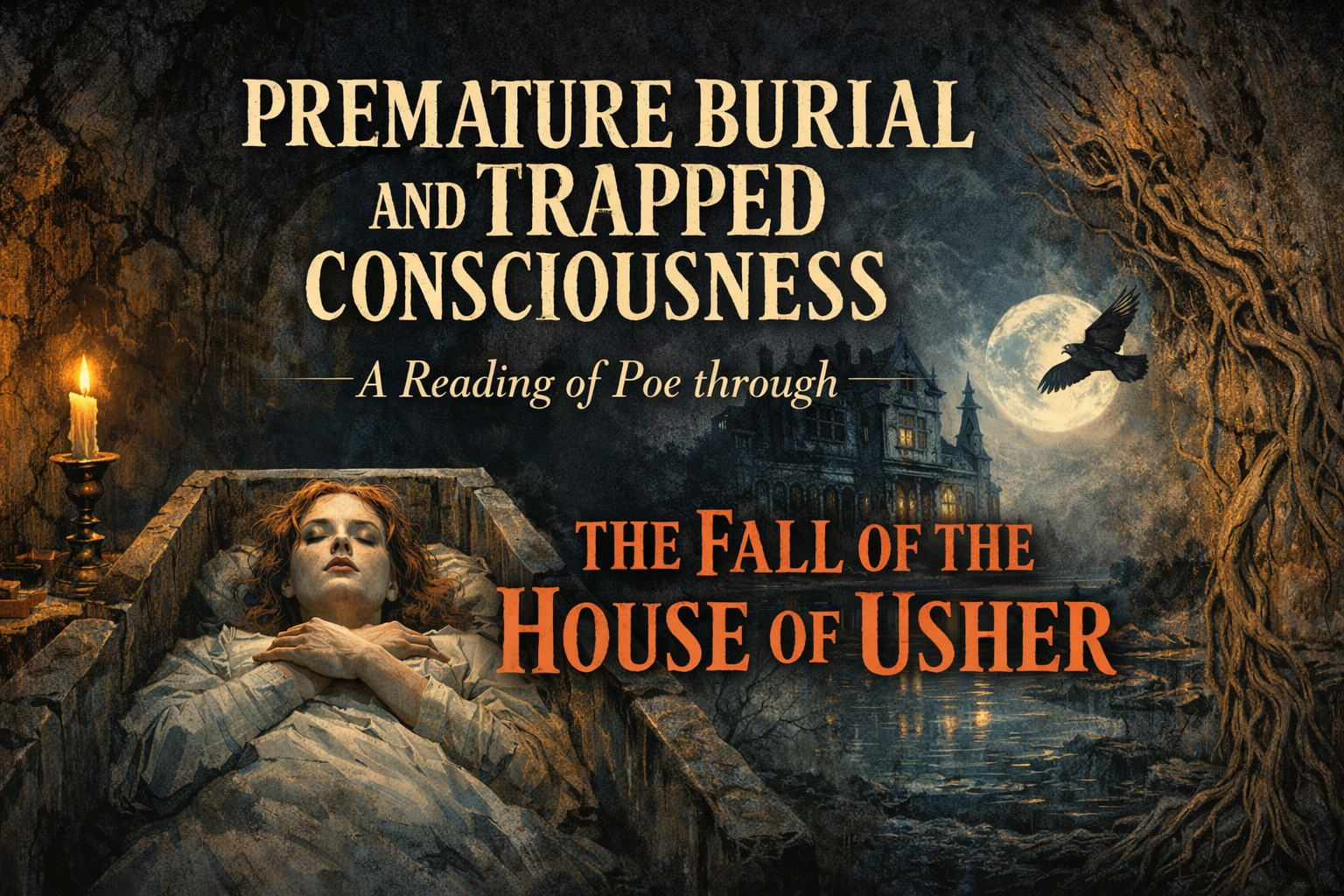
Premature Burial and Trapped Consciousness: A Reading of Poe through The Fall of the House of Usher
Introduction
Among the most persistent and disturbing motifs in the work of Edgar Allan Poe, premature burial occupies a central position, functioning not merely as a Gothic device but as a genuine theoretical construct. Starting from The Fall of the House of Usher (1839), one can trace a constellation of meanings that runs throughout Poe’s oeuvre: from the historically grounded fear of being buried alive to a more radical reflection on consciousness and the relationship between life and death.
This article explores the theme of premature burial as a point of intersection between psychological, symbolic, and ontological dimensions, showing how Poe transforms it into a privileged tool for destabilizing the fundamental categories of human experience.
1. The Fall of the House of Usher: Burial as Repression
In the tale, the figure of Madeline Usher represents one of the most emblematic instances of premature burial. Presumed dead and placed in the family crypt, she returns at the narrative’s climax, triggering the final collapse of both the house and the lineage.
This episode can be read, first and foremost, as a narrative dramatization of the return of the repressed. Madeline’s burial is an attempt to neutralize a disturbing element, to confine what exceeds the symbolic order of the house/family. Yet this operation ultimately fails: what is buried is not eliminated, but suspended in a liminal state, destined to re-emerge with greater violence.
In this sense, the crypt is not merely a physical space, but a metaphor for psychic repression. Its final violation signals the impossibility of maintaining a clear boundary between life and death, presence and exclusion.
2. The Historical Dimension of Fear
The power of the premature burial motif in Poe cannot be fully understood without considering the cultural context of the early nineteenth century. At a time when medical practices were still unreliable and the boundary between life and death was often uncertain, the fear of being buried alive was widespread and deeply rooted.
Poe draws on this collective anxiety but reshapes it in a distinctly personal way. In his tales, premature burial is never merely an accident or a misfortune; it becomes an existential condition, a state of trapped consciousness that transcends empirical reality to assume metaphorical significance.
3. Consciousness and Liminality
One of the most significant aspects of this motif is its ability to destabilize the distinction between life and death. The prematurely buried subject belongs fully to neither category, existing instead in an intermediate, liminal state.
This liminality reflects Poe’s broader fascination with transitional states:
- between consciousness and unconsciousness
- between matter and spirit
- between presence and absence
Premature burial thus becomes the paradigm of an incarcerated consciousness, forced to experience itself within a body that has already, in some sense, become a tomb. Poe’s insistence on sensory details—darkness, immobility, spatial compression—contributes to a phenomenology of entrapment.
4. Body, House, Tomb: A Symbolic System
In Usher, as in many of Poe’s works, there emerges a strong symbolic equivalence between the human body, architectural space, and the tomb. The House of Usher, with its enclosed and decaying structure, functions as a vast coffin containing its inhabitants.
Similarly, the body itself can be interpreted as a claustrophobic container of consciousness. Within this tripartite analogy:
- the body is a tomb
- the house is a body
- the tomb is a house
Premature burial is therefore not an exceptional event, but the revelation of an already existing condition. It makes visible what usually remains implicit: that human existence is structurally bound to a form of confinement.
5. Trauma and Repetition
The recurrence of premature burial in Poe’s work can also be read in light of his biography, marked by early and repeated losses. The death of beloved women introduces a tension between disappearance and persistence, absence and return.
In this sense, premature burial can be interpreted as an extreme form of denial of death: the body is not entirely lost, but remains accessible, albeit in a monstrous state. Yet this denial inevitably collapses into its opposite, producing anxiety and disintegration.
6. Toward an Ontological Reading
Pushing the analysis beyond psychological and symbolic levels, the motif of premature burial can be understood as a reflection on the very nature of human existence. From this perspective, it is not so much the dead who remain alive, but the living who are already in a state of burial.
Consciousness, far from being a liberating force, appears instead as something that intensifies the experience of limitation. To be conscious is to be aware of one’s finitude, of the impossibility of escaping a closed system—whether it be the body, the house, or the world itself.
Conclusion
The theme of premature burial in Poe, far from being a mere Gothic trope, emerges as one of the deepest keys to understanding his poetics. Beginning with The Fall of the House of Usher, it reveals itself as a complex device capable of articulating:
- a historically grounded fear
- a psychological dynamic rooted in repression
- a symbolic structure linking body, space, and death
- a radical reflection on the condition of consciousness
Ultimately, the prematurely buried figure is not just a narrative construct, but a powerful metaphor for human existence itself: a condition in which life and death, presence and absence, are never fully separable.