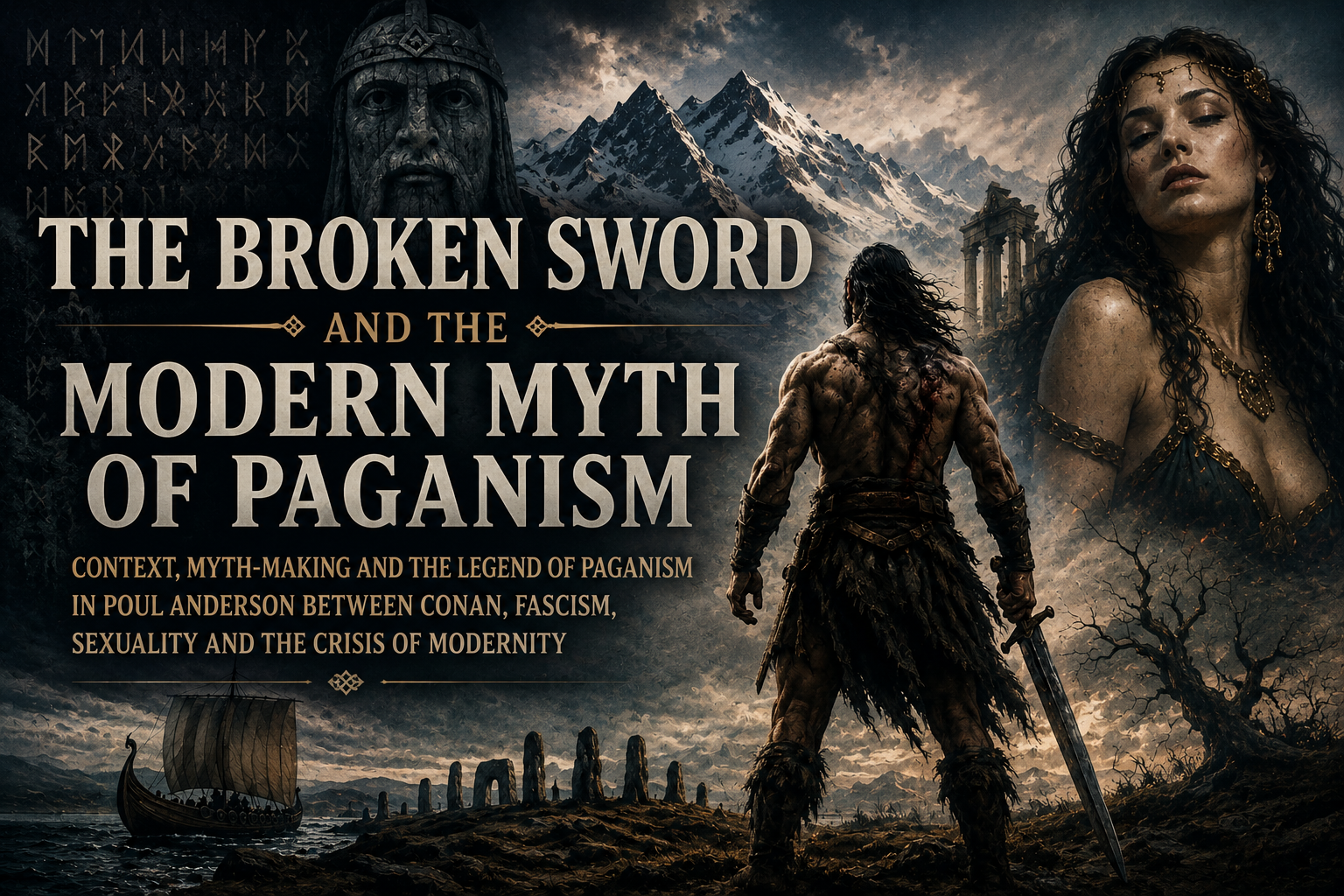
The Broken Sword and the Modern Myth of Paganism
When discussing twentieth-century fantasy literature, The Broken Sword by Poul Anderson is often presented as the “pagan alternative” to Tolkien’s The Lord of the Rings. Where Tolkien builds a cosmology shaped by providence, moral order, and Christian ethics, Anderson offers a darker universe ruled by fate, violence, and tragic inevitability.
At first glance, Anderson’s novel appears closer to the original Norse imagination: harsher, more fatalistic, less constrained by Christian morality. Yet reading the novel today reveals a more complex reality. The Broken Sword is not a reconstruction of historical pagan culture, but a modern myth about paganism itself — a twentieth-century Anglo-American fantasy of the North.
The novel rejects Christianity metaphysically while preserving many of the cultural and social assumptions of the modern Western world that produced it.
The Postwar Context: 1954 and the Search for Lost Heroism
The Broken Sword was published in 1954, the same year as The Fellowship of the Ring. This was not a neutral historical moment.
The Anglo-American world of the 1950s was shaped by the aftermath of World War II, the beginning of the Cold War, rapid industrial expansion, the consolidation of bourgeois domestic life, rigid gender roles, and an increasing crisis of spiritual meaning within modern secular societies.
Fantasy literature became one way of responding to this crisis.
In Anderson’s case, the response takes the form of a violent and tragic North: a world of swords, bloodlines, doom, and supernatural warfare. But this “return to paganism” is already filtered through the anxieties of postwar modernity.
The pagan world of the novel is not medieval Scandinavia. It is an industrial civilization dreaming about a lost heroic age in order to compensate for its own sense of spiritual exhaustion.
The result is less a historical vision than a modern mythological reconstruction.
From Conan to Anderson: The American Myth of Barbaric Vitality
The pagan imagination of The Broken Sword did not emerge in isolation. Long before Anderson, American fantasy had already developed its own mythology of anti-modern barbarism through the work of Robert E. Howard.
In the 1930s, Howard’s Conan stories established many themes that would later reappear throughout modern fantasy:
- the opposition between barbarism and decadent civilization;
- the glorification of violence and primal vitality;
- distrust toward urban sophistication;
- the cult of masculine strength;
- and the fascination with pre-Christian worlds imagined as more authentic and existentially intense.
Howard’s barbarians are not historical reconstructions. Like Anderson’s North, they are modern mythic projections created within the anxieties of industrial America during the interwar period.
Conan embodies a fantasy of uncorrupted vitality against the perceived sterility of modern civilization. Civilization in Howard is frequently associated with decadence, weakness, bureaucracy, and spiritual exhaustion, while barbarism becomes a source of authenticity and existential clarity.
Anderson inherits much of this structure, though in a more tragic and mythological form. Where Howard emphasizes raw vitality, Anderson emphasizes doom and fatalism. Yet both writers participate in the same broader cultural movement: the construction of a modern pagan imaginary as an alternative to the perceived exhaustion of Western modernity.
In this sense, The Broken Sword belongs not only to the legacy of Norse mythology, but also to a distinctly American literary tradition that transformed paganism into a symbolic language of masculinity, violence, and spiritual recovery.
The Shadow of Northern Myth After Fascism
The modern reconstruction of pagan Northern mythology in twentieth-century fantasy cannot be separated entirely from the political history of Europe before and during World War II.
By 1954, the Nazi regime had already collapsed, but its symbolic use of Germanic and Norse imagery remained part of the cultural memory of the West. Runes, heroic fatalism, bloodline mythology, warrior aristocracy, and the idea of an ancient Northern spirit had all been appropriated and mythologized by fascist aesthetics during the previous decades.
This does not mean that The Broken Sword is a fascist novel, nor that Anderson consciously reproduces Nazi ideology. The relationship is far more indirect and cultural than political.
What matters is that the novel emerges from a Western world where the mythology of the North had already been transformed into a symbolic language of authenticity, virility, destiny, and civilizational identity.
After the war, these mythic structures did not disappear entirely. They survived in depoliticized and aestheticized forms: in fantasy literature, heroic fiction, tragic masculinity, and romantic longing for a premodern organic world.
In this sense, The Broken Sword can be read as part of a broader twentieth-century attempt to reclaim Northern myth after its ideological contamination by fascism — while still preserving some of its emotional and aesthetic power.
The novel strips Northern mythology of explicit political doctrine, yet retains many symbolic elements that had fascinated European modernity for decades: heroic violence, blood destiny, aristocratic fatalism, and the spiritualization of warfare.
What remains is a mythology no longer openly political, but still deeply tied to modern Western anxieties about decline, identity, and lost transcendence.
Rejecting Christian Ethics Without Escaping Christian Modernity
One of the novel’s most striking features is its rejection of Christian moral structure.
There is no providence in Anderson’s universe. No redemptive order. No ultimate reconciliation between suffering and meaning.
Fate in The Broken Sword is blind and destructive. Violence is not redeemed; it is woven into the fabric of existence itself.
In this sense, Anderson seems far removed from Tolkien. Tolkien transforms Northern mythology through a Catholic imagination, while Anderson attempts to restore its brutality and tragic fatalism.
Yet the novel never fully escapes the cultural world it opposes.
Although Anderson removes Christian metaphysics, many modern Western social assumptions remain intact. The result is a paradoxical universe: cosmologically pagan, but anthropologically modern.
The novel rejects God, but not necessarily the social structures inherited from Christian bourgeois civilization.
The Sexualization of Women and the Myth of the Pagan Feminine
This contradiction becomes especially visible in the representation of women.
Women in The Broken Sword are often portrayed less as historical subjects and more as symbolic forces: temptation, seduction, fatality, erotic mystery, and supernatural otherness.
Their role is frequently tied to male destiny and male tragedy. The feminine becomes aestheticized and mythologized rather than socially grounded.
This is particularly interesting because the historical Norse world was far more complex than the novel suggests. Women in medieval Scandinavian societies could own property, initiate divorce, manage households, influence clan politics, and actively shape family conflicts. The Icelandic sagas contain women with significant social and political agency.
Anderson’s female figures, however, often resemble twentieth-century archetypes far more than historical Norse women: the femme fatale, the dangerous seductress, the metaphysical object of male desire.
The novel liberates eros from Christian restraint while still framing femininity through modern masculine fantasy.
What appears to be “pagan authenticity” is therefore deeply shaped by the gender imagination of the Anglo-American 1950s.
Paganism as a Modern Myth of Masculinity
At the center of Anderson’s universe stands the tragic male hero: isolated, doomed, violent, and bound to destiny.
The mythology of the North becomes a mythology of masculine recovery. Against the bureaucratic and domesticated world of postwar modernity, the novel imagines a realm where identity is forged through combat, lineage, suffering, and heroic destruction.
This explains why the novel aestheticizes violence so intensely. Tragedy itself becomes sacred.
The paganism of The Broken Sword is therefore not simply anti-Christian. It functions as a replacement spirituality for a secular modern world still searching for transcendence.
Meaning survives, but it is relocated:
- from salvation to fate;
- from providence to doom;
- from morality to heroic suffering.
Conclusion
The Broken Sword is often celebrated as a return to authentic Northern paganism, free from Tolkien’s Christian moral universe. Yet the novel reveals something more historically revealing and culturally ambiguous.
Rather than recovering the pagan past, Anderson constructs a modern legend about paganism itself — one shaped by the anxieties, desires, and ideological structures of the Anglo-American postwar world.
Its gods may be pre-Christian, but its imagination remains deeply modern.
The novel rejects Christian metaphysics while preserving many of the social and gender assumptions inherited from Western bourgeois culture. In doing so, it reveals one of the central tensions of modern fantasy itself: the attempt to escape modernity through myth while remaining unable to fully leave modernity behind.