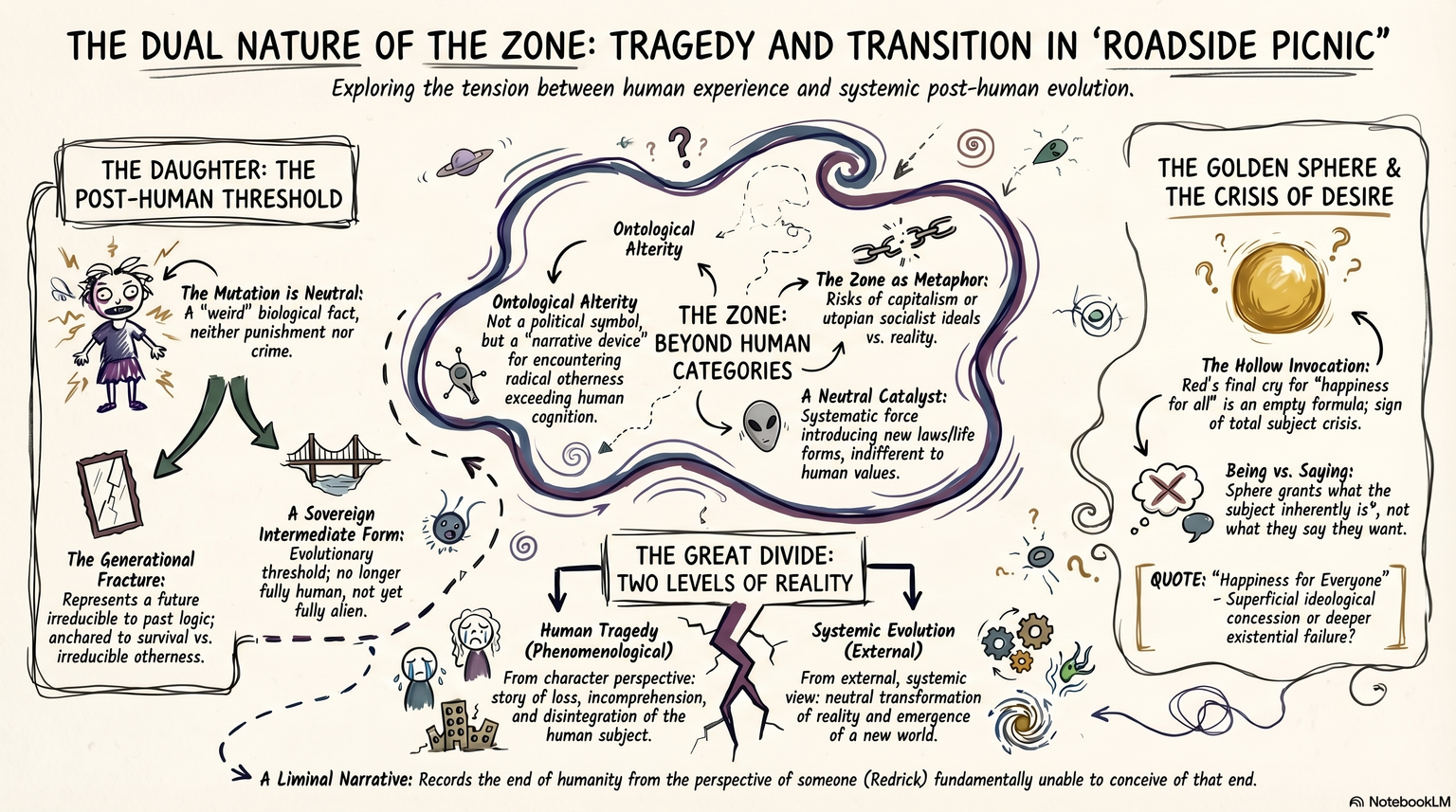
Beyond the Zone: Human Tragedy and the Mutation of Reality in Roadside Picnic
Published in 1972, Roadside Picnic by Arkady and Boris Strugatsky is one of the most radical works of twentieth-century science fiction. Set in a world marked by mysterious “Zones” — remnants of an incomprehensible alien visitation — the novel follows the figure of stalker Redrick Schuhart, a smuggler of forbidden objects, through a landscape in which reality itself seems to have lost coherence.
To reduce the novel to a story of exploration or alien contact, however, would be misleading. Rather, it functions as a philosophical laboratory in which the human condition is subjected to pressures that expose its structural limits.
The Zone as an “Epistemological Black Hole”
The Zone can be understood as a cognitive black hole: a space where the laws of the world continue to exist but cease to be comprehensible. Like an event horizon in physics, it marks a boundary beyond which human interpretive categories collapse.
Seemingly mundane objects — batteries, residues, invisible traps — operate as fragments of a technology that is not merely advanced but untranslatable. This is not a linear technological progression (as in classical science fiction), but a radical discontinuity: the Zone is not the next step on the human ladder, but an entirely different ladder.
In this sense, any attempt to read the Zone as a single allegory (capitalism, socialism, technology) is reductive. Rather than representing something, the Zone produces the very impossibility of representation.
The Ending: Desire or Automatism?
The novel’s famous ending, in which Red invokes “happiness for everyone,” is often read in ideological terms. Within the Soviet context, such a formulation may indeed echo collectivist ethics.
Yet a closer reading reveals a short circuit: Red reaches this moment through violence, loss, and existential disintegration. He is like a man who, standing before a machine capable of granting any wish, suddenly discovers he no longer possesses one.
His gesture resembles that of a program executing a default command in the absence of input: a phrase that emerges not from authentic will, but from a void. In this perspective, the Golden Sphere does not fulfill what the subject says, but what the subject is — or is no longer capable of being.
The ending, therefore, is not a celebration of altruism, but a diagnosis: the collapse of human desire in the face of the incomprehensible.
The Zone as an Evolutionary Event
If one suspends human judgment, the Zone appears as a radical evolutionary event:
- it alters the environment
- it produces mutations
- it introduces new causal dynamics
However, this is not evolution in the classical sense: there is no progress, nor any clear adaptation. Rather, it resembles a blind mutation, akin to a genetic disturbance on a cosmic scale.
In this regard, the novel anticipates contemporary sensibilities in which nature — or its substitute — is no longer a passive backdrop, but an opaque transformative agent.
The Genealogical Line: Father, Son, Daughter
The evolutionary and tragic dimensions converge in the family structure of Red, which can be read as a fractured genealogical line.
Red’s father, dead yet returned as an automatic, unconscious presence, represents a residual survival of the past. He is not a ghost in the traditional sense: he does not communicate, transmit, or signify. He is a body that persists, like a mechanism that continues to operate after losing its function.
Red occupies the intermediate position: still human, yet deeply disoriented. His consciousness is no longer able to organize the world coherently; he exists in a permanent state of transition, unable either to return to the past or to comprehend the future.
His daughter, finally, embodies the decisive rupture: she is no longer fully human, nor interpretable through previous categories. She is a new, opaque, irreducible form.
This triad can be schematized as follows:
- the father → presence without consciousness (the emptied past)
- Red → consciousness without orientation (the present in crisis)
- the daughter → transformation without humanity (the incomprehensible future)
The Father as Historical Inertia
From a historical perspective, the father can be interpreted as an expression of inertial pastness. He embodies a generation — that between the two world wars — whose historical project has been exhausted, yet continues to exert pressure on the present.
He is like a physical system that, even after losing its active energy, continues to move by inertia. The father does not act; he persists.
This presence differs fundamentally from that of the Zone:
- the Zone introduces discontinuity
- the father represents an emptied continuity
The family thus becomes an embodied temporal diagram:
- residue (father)
- transition (Red)
- mutation (daughter)
Tragedy and Evolution: A Double Register
The novel operates on a dual level:
- Internal (human) level: dominated by Red’s perspective, marked by loss, failure, and incomprehension. Here, the Zone is a tragedy.
- External (systemic) level: observed without anthropocentrism, it reveals a reality that transforms, generates new forms, and introduces new laws.
It is like observing a fire: for those inside the house, it is destruction; for an external observer, it may be part of a broader process. The novel does not resolve this tension but sustains it.
Conclusion: An Ending Seen from Within
Roadside Picnic can ultimately be read as the chronicle of an ending:
the end of the human as the measure of the world.
Yet this ending is narrated from within, through the perspective of someone who lacks the tools to recognize it as such. Red is not a privileged witness, but a survivor attempting to interpret an event that exceeds his capacity for understanding.
The Zone, then, is not merely a place. It is a threshold. And the novel is the account — incomplete, distorted, yet profoundly human — of what happens when that threshold is crossed.