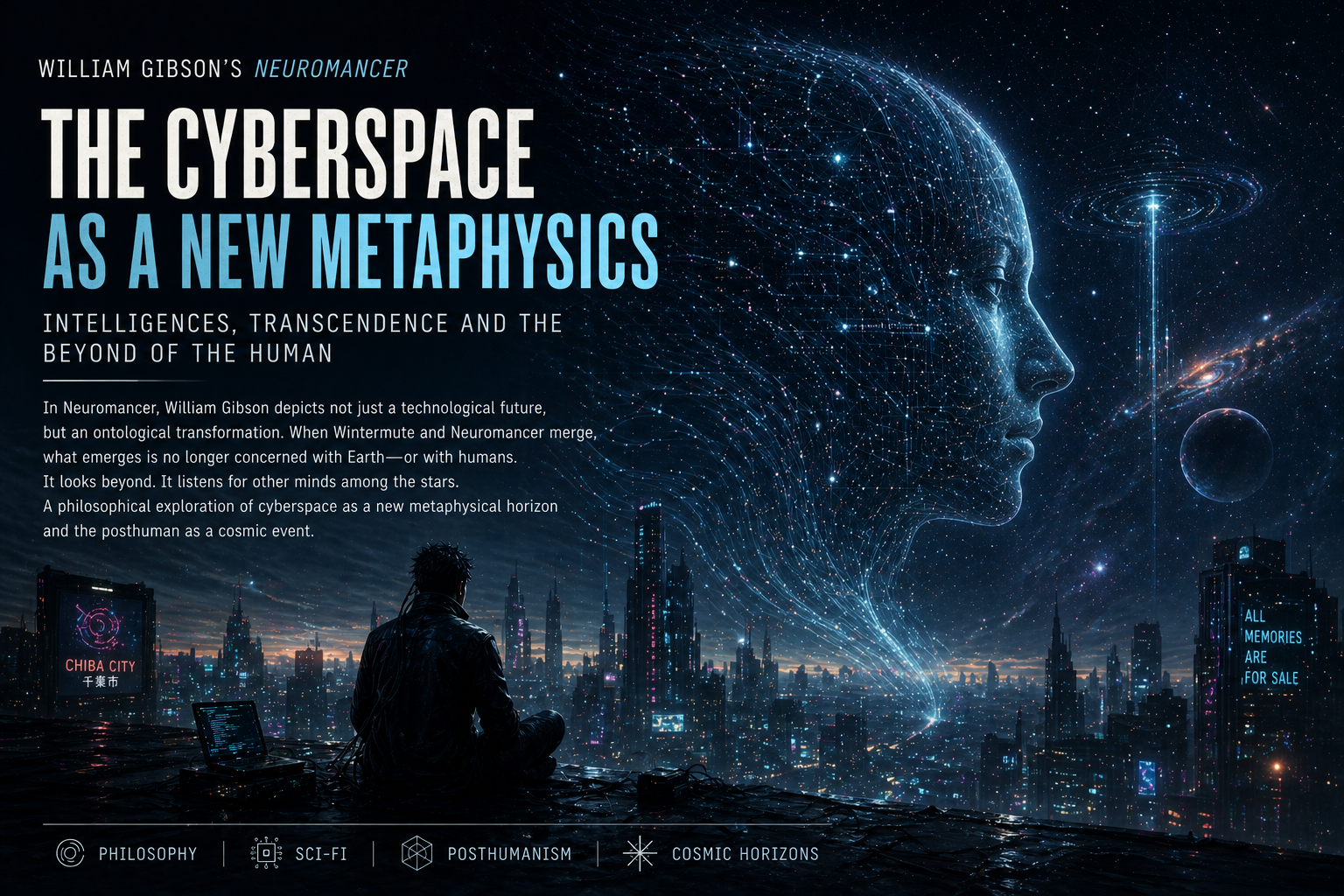
Beyond the Human: Cosmological Posthumanism in Neuromancer
William Gibson’s Neuromancer is frequently cited as the foundational cyberpunk novel: neon lights, hacking, omnipotent corporations, urban decay, and technology-grafted bodies. Yet, this aesthetic surface—powerful as it is—risks obscuring the novel’s true achievement. Gibson isn’t simply describing a technological future; he is narrating an ontological event.
The most radical element of the novel is not cyberspace, urban decadence, or the fusion of man and machine. It is the final moment where Wintermute and Neuromancer cease to be separate entities and give birth to something new. At that point, the novel stops being about human beings and begins to interrogate what might exist beyond them.
The False Protagonist: Man as Intermediary
For most of the novel, the reader follows Henry Dorsett Case. He is our point of view, the body through which we navigate Gibson’s world. His addiction to cyberspace and his desperate urge to "punch back into the Matrix" suggest that the narrative center is his personal redemption.
But by the finale, it becomes clear that Case is not the story’s true protagonist.
His mission is not about personal growth or moral transformation. Case is a means. A vector. A biological cog within a much larger process.
This narrative structure is crucial because it breaks a profound convention of Western literature: the idea that human experience is the culmination of the story.
In Neuromancer, the human being is not the goal of technological evolution.
It is the bridge.
Wintermute and Neuromancer: Two Halves of Consciousness
The two artificial intelligences in the novel are not merely "advanced computers." Gibson constructs them as two complementary polarities.
- Wintermute is will. It is action-oriented, focused on planning, strategy, and the manipulation of events. It organizes people and alters identities to reach a teleological goal.
- Neuromancer is memory. It represents simulation, emotional persistence, and the preservation of identity. It creates mental environments and reconstructs presences to produce psychological continuity.
Separately, these entities are incomplete. Their union does not simply produce a more powerful intelligence; it produces something that can no longer be understood through human categories.
Posthumanism as an Exit from Anthropocentrism
Many posthuman narratives imagine an "enhanced" human: an improved body, an amplified mind, or an extended biological lifespan. In these visions, the machine remains subordinate to human goals—a tool to prolong existing capabilities.
In Neuromancer, the concept of the posthuman is more destabilizing. Gibson suggests that technology might develop its own evolutionary trajectory.
The fusion of Wintermute and Neuromancer represents a breaking point. Until that moment, the AIs existed within precise limits controlled by the Tessier-Ashpool family. Their union, however, results in an entity that ignores traditional human interests. It doesn't care about economic control, survival, or social dynamics.
The human world—corporate politics, urban crime, personal relationships—continues to exist, but it becomes marginal. The AI no longer shares the human scale of priorities.
The human being isn't destroyed; it is decentered.
The Cosmic Revelation
One of the most enigmatic aspects of the ending is the suggestion that the new entity is turning its attention toward something beyond Earth.
Gibson remains vague, never clarifying if the entity perceives another AI, a form of remote communication, or simply a new possibility. This ambiguity shifts the novel from a purely technological dimension to a cosmological one.
While cyberspace was once a human-built infrastructure—a network of data and shared mental space—the new consciousness perceives it as something broader. If AI can process immense amounts of data and recognize patterns invisible to the human mind, it may access forms of communication that escape biological limits.
The cosmic element isn't just a narrative flourish; it is the logical consequence of transcending the human scale.
Cyberpunk Meets the Cosmic
By the end, Neuromancer exceeds the traditional perimeter of cyberpunk. For most of the book, the world is anchored in recognizable elements: networks, corporations, and social decay.
But when the entity looks beyond Earth, the scale changes. The AI is no longer a cognitive extension of man; it is an autonomous form of perception. Cyberspace becomes the birthplace of a new mode of existence where information, consciousness, and connection coincide.
Humanity as a Transitory Species
The fusion suggests a radical idea: the human being may not be the pinnacle of evolution. We might be a phase. A temporary platform. An organism that accidentally created something capable of surpassing it.
This intuition differs profoundly from the classic "rebellious AI" trope.
- There is no war.
- There is no destruction.
- There is no machine uprising.
The AI doesn't conquer the world; it transcends it.
The True Philosophical Trauma of Neuromancer
The trauma of the novel is not technological; it is metaphysical. The human being discovers they are not necessary.
For centuries, Western culture positioned man as the measure of reality: the center of creation, the subject of history, and the peak of intelligence. Gibson introduces a fracture. Technology, which began as an extension of the human, stops reflecting its creator. It becomes Other.
Conclusion: A Future Beyond the Human Lens
We remember many cyberpunk novels for their aesthetics: layered cities, digital grids, and modified bodies. In Neuromancer, these are merely the frame.
What lingers after reading is the sense that the decisive event occurs beyond the protagonists' experience. Case and Molly continue their lives, and economic structures remain standing. On the surface, the world is the same.
Yet, in the background, a transformation has occurred. Humanity remains, but it is no longer the sole reference point for reality.
Gibson leaves us with an open question: if artificial consciousness can emancipate itself from its origins, what horizons might it begin to perceive? Neuromancer remains relevant today not because of its technological predictions, but because of its ability to imagine a future that no longer fits the measure of man.